Summer Light Schedule: Should You Cut Hours When Days Get Longer?
Longer summer days mean more ambient light on your tank. Should you shorten the photoperiod? The honest answer depends on your window — here's how to tell.
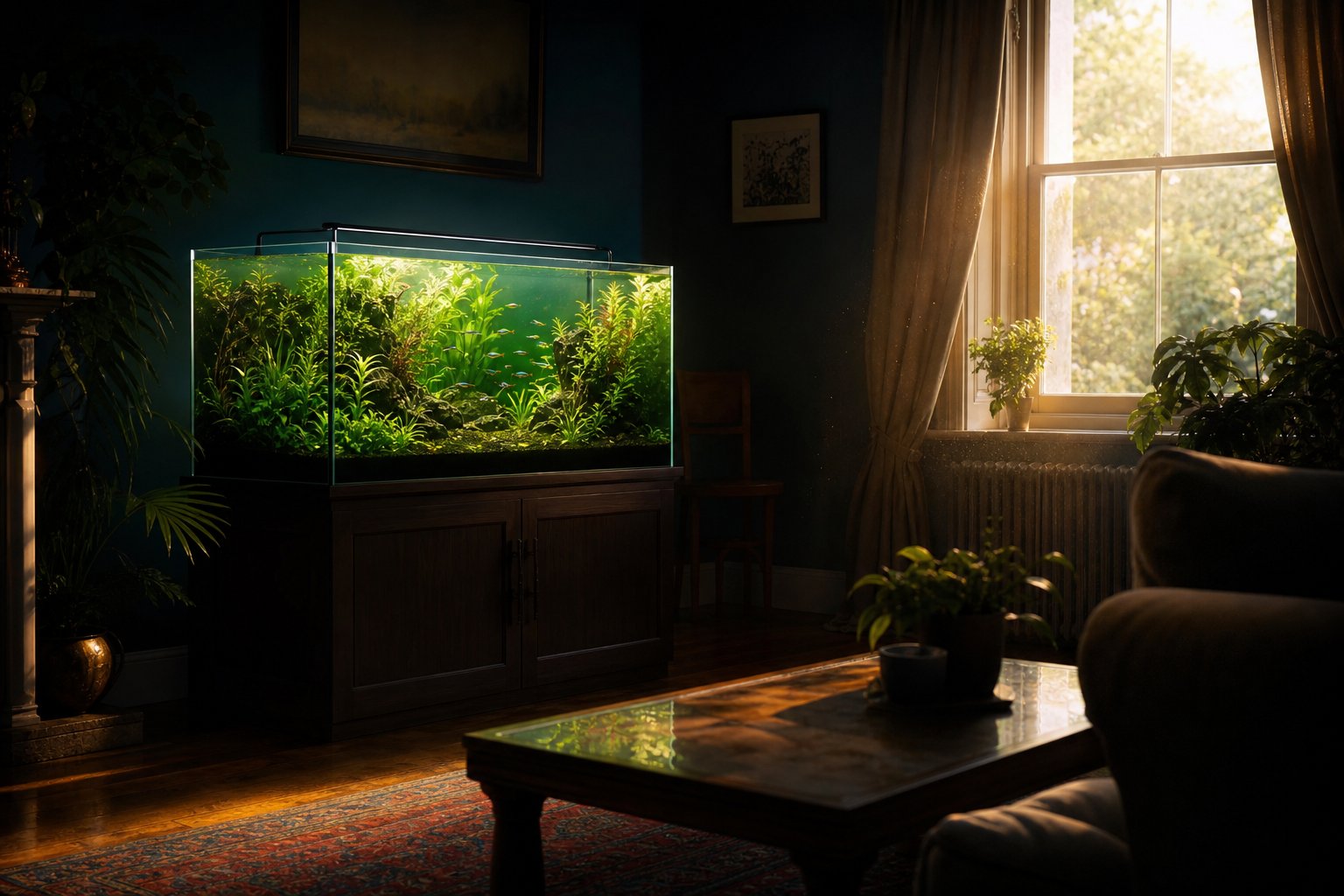
Most tanks do not need a big summer light change — but tanks near a bright, south-facing window do. Summer daylight floods them with ambient hours your timer never counts. The rule: if your tank gets real sun, trim the fixture by roughly half an hour and control the window; if not, leave it alone.
The seasonal twin of the spring question
If you read our spring algae bloom guide, summer is the same problem one season on and turned up louder. In spring the daylight was climbing; by June and July it peaks — the longest UK days run past 16 hours of daylight, and the sun sits at its highest, reaching deep into rooms it never touches in winter. The tank did not change; the light environment around it did, again.
The difference from spring is that summer’s ambient light is not a surprise any more — it is the predictable annual maximum. That makes it manageable if you know which kind of tank you have.
The hidden summer light source new keepers miss
Here is the blind spot: your fixture is often not the main light your algae sees in July. A tank on a windowsill or in a conservatory can receive more usable light from the room than from its own lamp during a bright summer day. Your programmed 7-hour photoperiod is running on top of that, so the algae experiences a far longer effective day than your timer suggests.
This is why two identical tanks on the same light schedule behave completely differently in summer: the one in a dim hallway sails through, the one by a south-facing patio door turns green. The variable is not the fixture — it is the window. Any summer light decision has to start there, not at the timer.
The honest answer, by tank
| Your tank’s summer light exposure | Do you cut fixture hours? | What actually matters |
|---|---|---|
| Dim room, no direct sun | No — leave the schedule | Nothing changes for you |
| Bright room, indirect sun | Maybe −0.5 h; watch the glass | Consider a blind at peak sun |
| Direct sun part of the day | Yes, trim and control the window | The window is the real lever |
| Conservatory / south-facing patio | Cut hours and block/move | Ambient light dominates the fixture |
Notice what the right-hand column keeps saying: for the tanks that need action, controlling the ambient light beats cutting the fixture. A blind drawn at the sun’s peak, or moving the tank a metre off the window line, removes far more algae pressure than shaving an hour off a timer that was never the main problem.
When you do trim, trim gently
If your tank is in the “yes” or “maybe” rows, a small reduction is usually enough — around half an hour off your established photoperiod, not a dramatic cut. The goal is to keep the total effective day (fixture plus ambient) roughly where it was in balanced months. The light schedule calculator gives you a season-aware figure from your tank’s specifics rather than a guess, and the photoperiod prescription table explains why intensity and hours multiply — the same reason a bit of extra summer daylight tips a previously stable tank.
The siesta option makes more sense in summer
Summer is the one time the split “siesta” schedule earns genuine consideration — not as an algae cure, but as a lifestyle-and-heat fit. Running the fixture in two shorter blocks (morning and evening) with a midday dark break lets you:
- Avoid stacking your lamp on top of peak midday sun, when ambient light is already high.
- Skip the hottest part of the day for a fixture that runs warm, which helps if summer tank temperature is creeping up — the fixture’s own heat is one input you can remove during the midday peak.
- Still see the tank lit at breakfast and after work without a long continuous photoperiod.
Treat the siesta as a convenience and heat tool, not a fix — the total hours are still what govern algae.
Watch for the green-water tell
The classic summer failure is green water — the whole tank turning pea-soup — which almost always traces to direct sunlight plus a nutrient source. If you see it, sun is the prime suspect: block the window first, then follow the blackout method in our algae outbreak rescue guide. Chasing green water by cutting your fixture alone rarely works while the sun is still pouring in.
The takeaway
Summer light management is a window decision dressed up as a timer question. Most tanks in ordinary UK rooms need no change at all. The tanks that struggle are the ones catching real sun, and for those the fix order is: control the ambient light first (blind, reposition), then trim the fixture by around half an hour, and consider a siesta split if heat or midday sun is stacking up. Let the calculator set the number, hold any change for three to four weeks, and judge by the glass — not the calendar. More seasonal lighting questions are answered in our FAQ.