How Long Should Aquarium Lights Be On? The Planted Tank Prescription Table
6, 8 or 10 hours? Get a light schedule prescription by tank age, CO2 and algae status — with a 4-week ramp-up plan UK fishkeepers can follow.
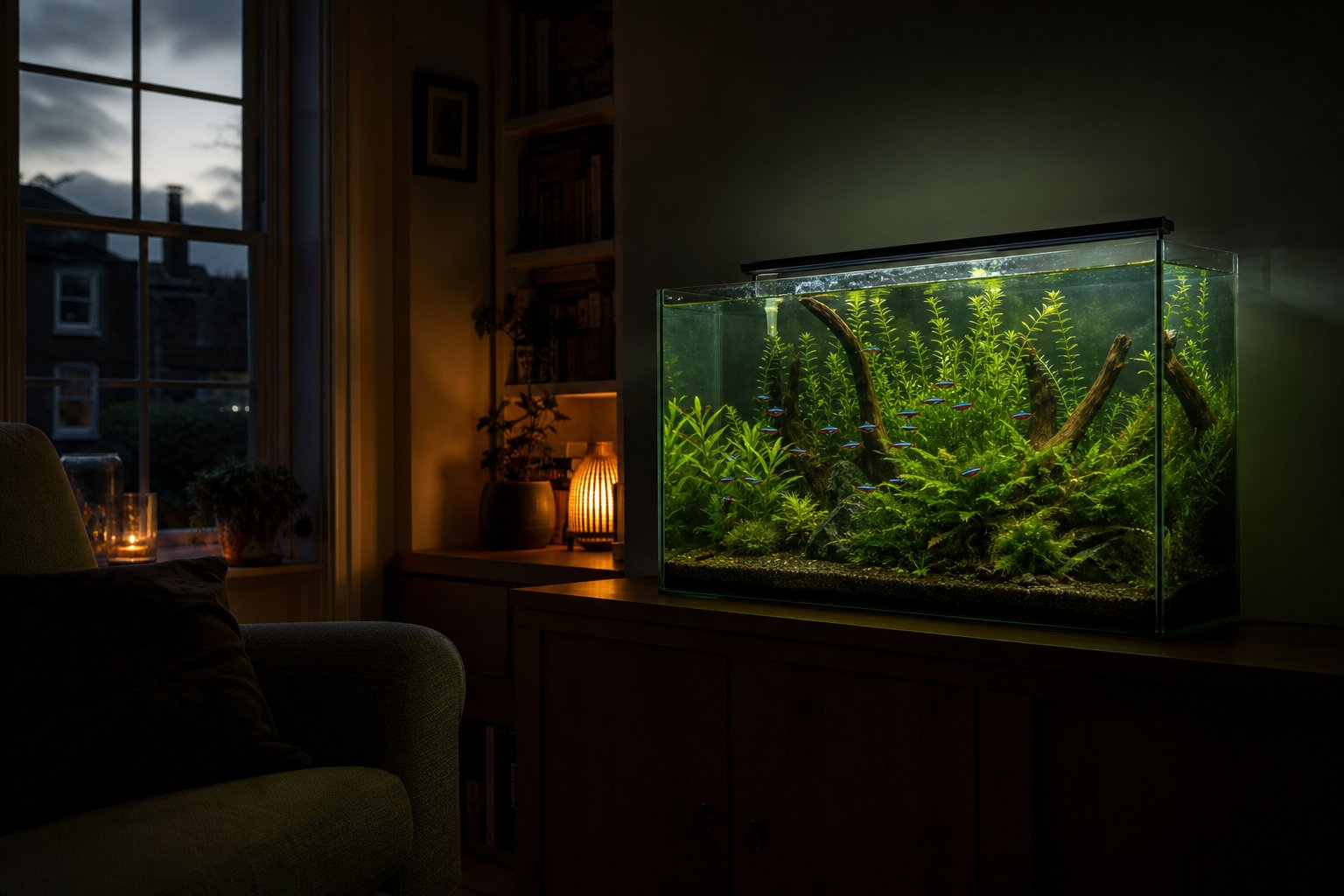
Most planted aquariums do best with 6 to 8 hours of light per day. Start new tanks at 6 hours, extend by 30 minutes a week only if plants are healthy and algae is absent, and cap low-tech tanks at 8 hours. Longer photoperiods feed algae faster than they feed your plants.
The honest answer nobody puts on the box
Aquarium lights — ours included — physically allow you to run 12, 16, even 24 hours of light a day. The default 24/7 programme on many fixtures spans roughly 16 hours from first sunrise glow to final moonlight. And this is where most new fishkeepers go wrong: they assume that if some light grows plants, more light grows them faster.
It does not work that way. Plant growth is limited by the scarcest resource — usually carbon dioxide, sometimes nutrients — not by light hours. Once your plants have used up the day’s available CO2, every extra hour of light is energy that only algae can use. Algae are simpler organisms with lower resource requirements; they thrive on exactly the surplus you create by being generous with the timer.
Experienced keepers know this. In one widely-shared planted tank post on Reddit, the owner of a lush, two-year-old moss tank noted simply: “It’s a Hygger light that I have on for 6 hrs a day.” Six hours. Meanwhile the tanks drowning in black beard algae are almost always running 10–12 hours, often because the light shipped with a long default schedule that nobody changed.
The prescription table
This is the part you came for. Find your row, read your hours. We built this table because the generic advice (“6–8 hours”) never tells you what to do with your tank’s specific situation.
| Tank situation | Daily light | Notes |
|---|---|---|
| Brand new tank (0–8 weeks), no CO2 | 6 hours | Non-negotiable. New tanks have no plant mass to absorb nutrients; algae wins any surplus |
| Brand new tank, injected CO2 | 6–7 hours | CO2 helps plants use the light, but hold back until the tank matures |
| Established (3+ months), low-tech, healthy | 7–8 hours | The sweet spot for most UK community tanks |
| Established, injected CO2, heavy plant mass | 8–9 hours | Only with consistent fertilisation and weekly maintenance |
| Established, high light fixture, no CO2 | 6 hours + reduce intensity | Strong light without CO2 is an algae recipe; dim to 50–70% if your fixture allows |
| Any tank currently fighting algae | Cut to 5–6 hours | Hold for 3–4 weeks; fix the imbalance before restoring hours |
| Fish-only, no live plants | 6–10 hours | Purely for viewing; shorter is always safer |
Two rules sit behind every row. First: consistency beats duration — 7 hours on a timer beats “roughly 8, whenever I remember” every time, because plants adapt to rhythm and algae exploits chaos. Second: intensity and duration multiply — a powerful planted-tank fixture at full brightness for 8 hours delivers far more total light than a weak lamp for 10; if your light has dimming, it is a second lever to pull before cutting hours.
The 4-week ramp-up plan for new tanks
Starting a new planted tank? Do not guess. Run this schedule:
- Week 1–2: 6 hours. Bright daytime phase only. Plants are establishing roots; algae pressure is at its lifetime maximum because the biofilter is immature.
- Week 3: 6.5 hours — only if glass stays clean and plant tips show new growth. Any brown dusting (diatoms) or green film: stay at 6.
- Week 4: 7 hours — same test. Diatoms in a new tank are normal and will pass; they are not a reason to panic, but they are a reason not to add light.
- After week 8: settle anywhere in the 7–8 hour band that fits your viewing schedule. The specific clock times do not matter to plants — only duration and consistency do. If you are out all day, 14:00–21:00 is a perfectly good window.
What about the “siesta” split schedule?
You will read about splitting the photoperiod — 4 hours on, a 2–4 hour dark break, then 4 hours on. The theory is that plants restart photosynthesis faster than algae after a break. Honest verdict: the evidence is mixed, and planted-tank authorities have repeatedly shown that tanks credited to the siesta usually improved because total hours dropped or CO2 stabilised. Where the siesta genuinely earns its keep is lifestyle fit: if you want to see your tank lit at breakfast and again in the evening without running 14 hours straight, a split schedule caps total light while covering both windows. Treat it as a convenience tool, not an algae cure.
Match the schedule to the fixture
A programmable light makes all of this automatic. The 24/7 cycle mode on our fixtures runs sunrise, daytime and moonlight phases on a fixed daily rhythm, while manual/DIY mode lets you set exact on/off times and brightness — which is the mode we recommend while following the ramp-up plan above, because you control the hours precisely. For choosing the right fixture strength for your tank size in the first place, see our planted tank LED lighting guide.
One practical note for UK homes: if your tank sits near a window, remember that summer daylight through glass counts as light your algae can use — a north-facing wall or a 30-minute shorter timer in June–August compensates.
And because a stable tank is a system, not a single setting: light drives photosynthesis, but temperature drives metabolism. A tank that swings between 22°C at night and 27°C in the afternoon will grow algae under a perfect light schedule. If you have not checked your heating recently, our titanium heater with external digital controller holds temperature to ±0.5°C and shows the actual reading at a glance — the thermal half of the same discipline this article applies to light.
Signs you have it right (and wrong)
Right: plant tips visibly growing week to week; glass needs a wipe once a week at most; fish colour vivid under the daytime phase; no drifting green haze.
Wrong — too much light: green dust returning within 2–3 days of wiping; black tufts on slow-growing plant edges (black beard algae); pea-soup green water. Cut back to 6 hours and see our algae rescue guide.
Wrong — too little light: stem plants dropping lower leaves; new growth pale and leggy, stretching toward the surface; carpet plants refusing to spread. Add 30 minutes per week, or raise intensity if dimmed.
Still unsure which band fits your setup? Our FAQ covers the specific model questions — including how to reprogram the default schedule, which ships longer than any planted tank should run.