Algae Outbreak Rescue: Diagnose by Type, Fix the Light, Save the Tank
BBA, green water, diatoms or green dust? Identify your algae, find the cause, and follow the exact light and maintenance fix for each type.
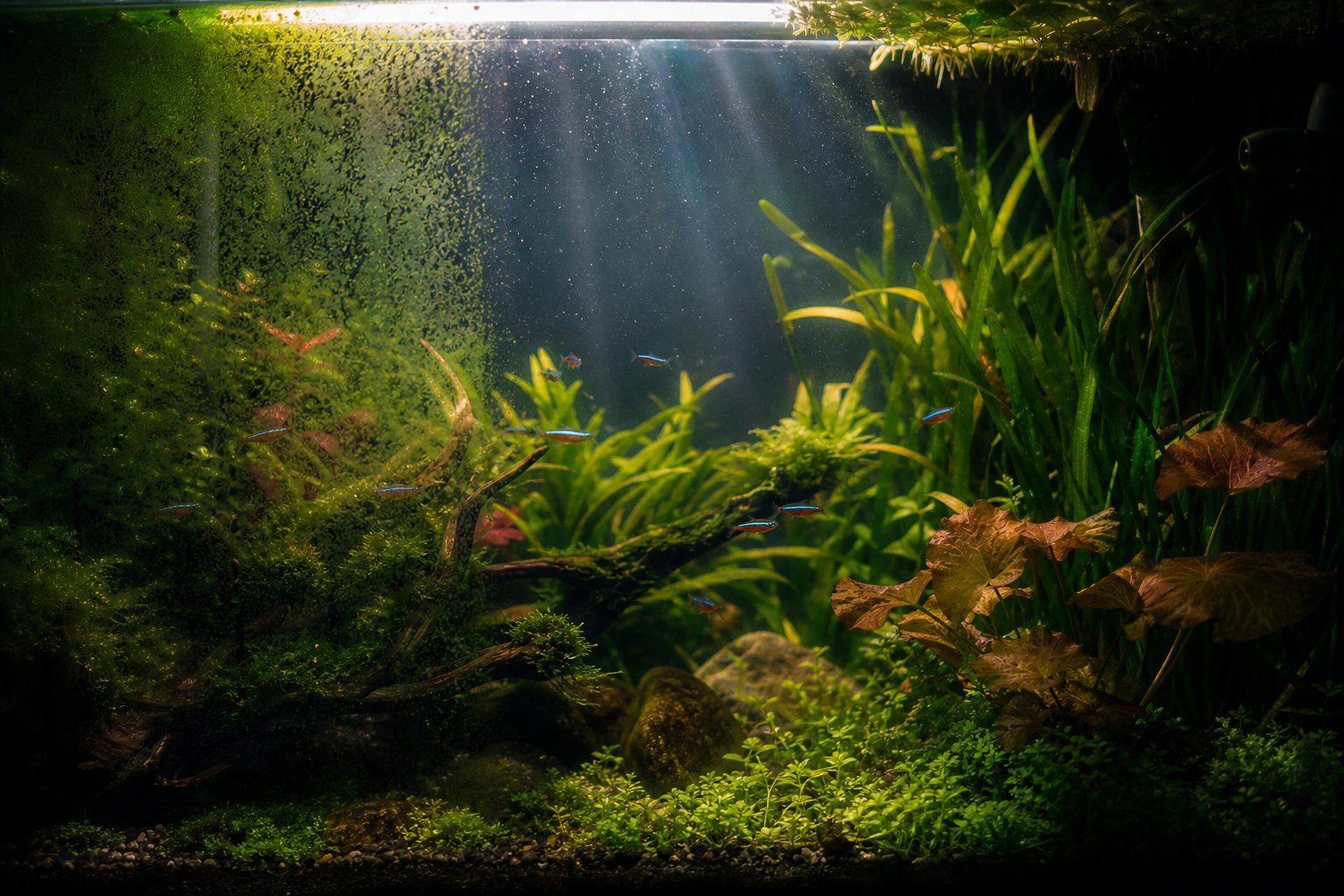
Almost every algae outbreak traces back to an imbalance between light, CO2 and nutrients — and light is the lever you control most directly. Identify your algae type first, because the fix differs: some types need less light, one needs to be left alone, and one signals a CO2 problem, not a lighting one.
Step 1: Identify what you are actually fighting
Treating the wrong algae wastes weeks. Match what you see against this table before changing anything:
| What you see | Algae type | Primary cause | Light-related? |
|---|---|---|---|
| Dusty brown coating, wipes off easily | Brown diatoms | New tank, silicates in tap water | No — patience |
| Soft green film on glass, returns days after wiping | Green dust algae (GDA) | Excess light in immature tank | Yes |
| Dark grey/black stiff tufts on leaf edges, wood, filter outlet | Black beard algae (BBA) | Unstable CO2 + high light | Partly |
| Water itself turns pea-soup green | Green water | Excess light + ammonia spike | Yes |
| Long green threads you can twirl on a toothbrush | Hair algae | Excess light + surplus nutrients | Yes |
Brown diatoms: the one you should not fight
If your tank is under three months old and everything is coated in brown dust, this is diatoms — and it is a phase, not a failure. Diatoms feed on silicates leaching from new substrate and tap water. They exhaust their food supply and disappear on their own, typically within four to eight weeks, as the tank matures.
The fix: wipe the glass during weekly maintenance, keep your light at 6 hours (see our light duration prescription table for the full new-tank schedule), and wait. Nerite snails and otocinclus catfish graze diatoms enthusiastically if you want to accelerate the process. What you should not do is respond by adding more light “to help the plants outcompete it” — in an immature tank, extra light feeds the next algae in the queue: green dust.
Green dust algae: the counterintuitive one
GDA coats the glass in a soft green film that wipes off beautifully — and returns within two or three days. Here is what most guides do not tell you: wiping it repeatedly is why it keeps winning. GDA has a spore-based lifecycle; each wipe releases zoospores back into the water to resettle.
The fix: stop wiping. Let it run its full cycle undisturbed for three to four weeks — yes, the glass will look terrible; that is the treatment working. At the end, the film matures, loosens its grip, and can be wiped off in one decisive session followed immediately by a large (50%) water change to remove the spores. Then cut your photoperiod by one to two hours from whatever level triggered the outbreak.
Black beard algae: the one that is not really about light
BBA — stiff, dark tufts colonising leaf edges, driftwood and anything in flowing water — is the most feared algae in the hobby, and the most misdiagnosed. Its primary trigger is unstable CO2, not raw light hours. Fluctuating CO2 (from inconsistent injection, erratic surface agitation, or big irregular water changes) prevents plants from photosynthesising steadily; high light then amplifies the imbalance.
The fix, in order:
- Stabilise the carbon side. If you inject CO2, check it comes on 1–2 hours before lights-on and holds a steady drop-checker green. If you do not inject, reduce light intensity or duration so demand matches the CO2 your tank naturally holds.
- Reduce light pressure. Cut to 6 hours and, if your fixture allows, dim to 50–70% while the tank rebalances.
- Remove what exists. BBA rarely dies from correction alone. Trim badly affected leaves. For hardscape and equipment, spot-treat with 3% hydrogen peroxide from a syringe (filter off for five minutes, no more than 1 ml per 4 litres of tank volume in any session) — treated tufts turn pink-white within 48 hours and die.
- Improve flow. BBA loves dead spots with pooled nutrients. Reposition your filter outlet so gentle current reaches the former trouble zones.
Green water: the nuclear-response one
When the water itself turns green, you are dealing with free-floating single-celled algae — usually after an ammonia spike (new tank, overfeeding, disturbed substrate) meets generous light.
The fix: a full blackout. Cover the tank completely with towels or blankets for three to four days. No peeking — even brief light restarts the bloom. Feed nothing (fish are fine for this period). Free-floating algae cannot survive 72+ hours of darkness; rooted plants can. Follow with a 50% water change. If you keep getting green water, check for direct sunlight on the tank — a surprisingly common cause in UK conservatories and south-facing rooms in summer — and audit your feeding.
After the rescue: the stability protocol
Whatever type you fought, the relapse-prevention plan is the same three disciplines:
Light discipline. Put the light on its programmed schedule and never freelance. 6 hours for recovering tanks, extending by 30 minutes per week only while the tank stays clean. A fixture with a built-in daily programme removes the human error — the failure mode here is always “I left it on because we had guests.” Our planted tank lighting guide covers choosing an appropriately-sized fixture, because an overpowered light run at full intensity is a standing invitation for round two.
Nutrient discipline. Weekly 30–50% water changes remove the dissolved organics algae feed on. Stock fast-growing stem plants or floating plants — they are your competitive allies, absorbing surplus nutrients faster than algae can.
Temperature discipline. The overlooked one. Water temperature swings stress plants (slowing their nutrient uptake) while barely bothering algae — a daily swing of more than 2°C quietly tilts the contest. Cheap heaters with drifting thermostats cause exactly this. Our titanium heater with external controller holds ±0.5°C and displays actual water temperature continuously, so a drift is visible before it becomes an algae assist.
When to accept some algae
A mature, healthy tank is not a sterile tank. A little green spot algae on rocks, a faint film on the glass by week’s end — this is a functioning ecosystem, and shrimp and snails make a living from it. The goal of this guide is not zero algae; it is algae that never again decides how your tank looks. Fix the imbalance, hold the schedule, and the plants win by default.