PAR, Spectrum and Kelvin Explained: How Much Light Does Your Planted Tank Actually Need?
What PAR numbers mean, why full spectrum beats watts, and how to match light intensity to your plants — a plain-English guide for UK fishkeepers.
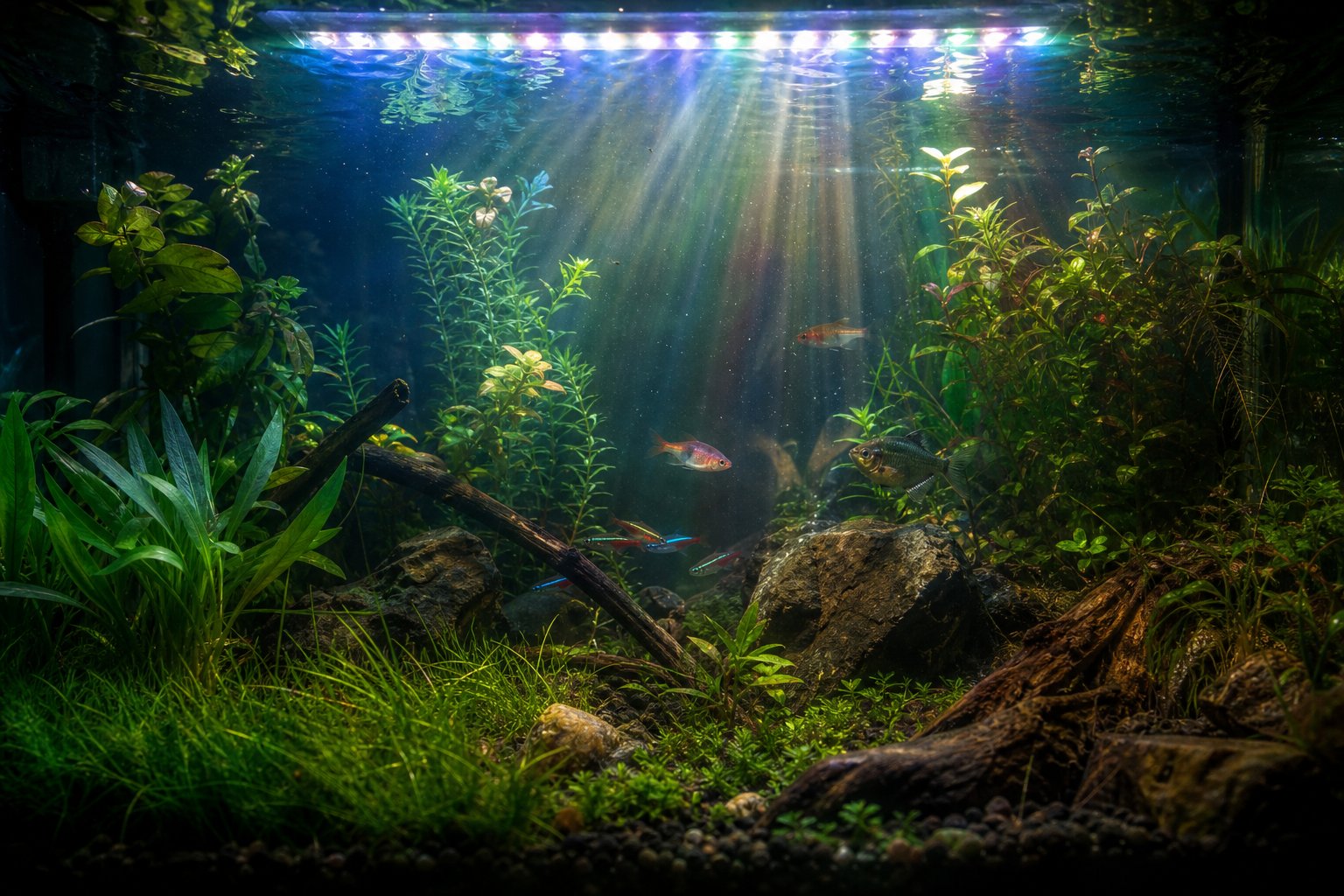
PAR (Photosynthetically Active Radiation) measures how much usable light actually reaches your plants — and it is the number that matters, not watts. Low-light plants need roughly 20–40 PAR at the substrate, high-tech carpets need 40–80+, and spectrum determines how efficiently plants use whatever PAR they receive.
Why watts stopped meaning anything
A decade ago, “watts per gallon” was the hobby’s rule of thumb. LEDs broke it. A modern 18W LED fixture can out-deliver an old 40W fluorescent tube, because efficiency per watt varies enormously between diode types, optics and driver quality. Watts tell you what a light costs to run (useful for your electricity bill — more on that in our winter running-cost content), but nothing reliable about what your plants receive.
What plants care about is PAR: the photon flux in the 400–700 nm wavelength band that photosynthesis can use, measured in micromoles per square metre per second (µmol/m²/s). Crucially, PAR is measured at a location — a fixture might deliver 120 PAR just under the lamp and 30 PAR at the substrate of a 45 cm-deep tank. Depth, water clarity, and even your floating plants all tax the number on its way down.
The PAR bands that matter
| PAR at substrate | Category | What grows well |
|---|---|---|
| 15–30 | Low light | Anubias, Java fern, mosses, Cryptocoryne, Bucephalandra |
| 30–50 | Medium light | Most stem plants, Vallisneria, swords, easy carpets (Marsilea) |
| 50–80 | High light | Demanding carpets (Monte Carlo, HC Cuba), red stems at full colour |
| 80+ | Very high light | Competition-grade scapes — CO2 and daily fertilisation mandatory |
Two honest warnings come with this table. First, more PAR is not a free upgrade: every band above 30 PAR increases algae pressure proportionally, and above 50 PAR you are committing to CO2 injection and disciplined fertilisation, or algae will take the surplus. This is the same balance logic as our light duration guide — intensity and hours multiply.
Second, most manufacturers (including, historically, the budget end of the market where Hygger competes) publish either no PAR data or a single number measured in air at zero distance, which is marketing, not physics. We are fixing this for our own range with a five-point underwater survey — tank-bottom centre plus four corners, at 30, 45 and 60 cm depths, on a calibrated quantum sensor, three units per model averaged. Until those numbers are on this page, we will not quote PAR figures for specific models — and we suggest treating any retailer who quotes suspiciously round numbers with the same scepticism.
Spectrum: why “full spectrum” is more than a buzzword
Chlorophyll absorbs most efficiently in two bands: red around 660 nm and blue around 450 nm. Green light is largely reflected (which is why plants look green). So why not just run red and blue diodes, grow-light style?
Three reasons. First, pure red-blue light renders an aquarium in ghastly purple — you keep fish to look at them. Second, research on aquatic plants shows green and yellow wavelengths penetrate deeper into leaf tissue and water, contributing more to photosynthesis in practice than absorption charts suggest. Third, fish colour and natural behaviour respond to daylight-like spectrum.
A good full-spectrum planted-tank light therefore mixes: strong white output around 6500–7500 K (the “daylight” band that makes water look crisp and plants look natural), plus dedicated red diodes to push plant growth and make reds pop, plus blues for dawn/dusk phases. Our full-spectrum lighting explainer goes deeper on the colour-rendering side.
Kelvin, decoded: colour temperature describes the white light’s warmth. 6500 K approximates midday daylight and is the planted-tank standard; below 5500 K looks yellow and cosy but muddies greens; above 10000 K goes icy blue (a marine aesthetic, wasted on freshwater plants). Kelvin says nothing about intensity — a 6500 K keyring torch and a 6500 K stadium floodlight are the same “colour”.
Matching light to your actual tank: a self-audit
Skip the spec-sheet wars. Answer four questions:
- What do you want to grow? If your list is Anubias, Java fern, moss and Crypts — congratulations, you need less light than you think, and a mid-priced full-spectrum fixture at moderate brightness covers you entirely. Demanding carpets or saturated red stems? You need genuine 50+ PAR at substrate, CO2, and the maintenance hours that come with them.
- How deep is your tank? Light falls off steeply with depth. A fixture that is generous on a 30 cm-deep nano is marginal at 45 cm and inadequate at 60 cm. Depth is the single biggest reason identical lights produce opposite verdicts in reviews.
- Do you inject CO2? No CO2 puts a ceiling on how much light your plants can use — roughly the “medium” band. Buying a very high-output light for a low-tech tank buys you algae, not growth.
- Does the fixture dim? Adjustable intensity is the escape valve. A light with 10-level dimming lets you start at 50%, watch the tank respond, and add output gradually — the intensity equivalent of the ramp-up schedule in our duration guide.
Where budget fixtures honestly fit
Independent reviewers are right that a £30–60 fixture will not out-muscle a £200 Chihiros on a high-tech showpiece — and we would rather tell you that here than have a forum tell you after purchase. What a well-designed budget full-spectrum LED does deliver: comfortable low-to-medium PAR for the plant list 80% of UK fishkeepers actually grow, proper 6500 K+ rendering, programmable cycles, and money left over for the equipment that keeps the system stable — plants, substrate, and reliable heating. On that last point: light drives growth, but temperature stability determines whether growth is steady or stressed. A titanium heater with an external controller that holds ±0.5°C is the unglamorous other half of the “stable inputs” principle this whole article rests on.
The takeaway
Ignore watts. Think in PAR bands (and demand real, in-water measurements), buy the spectrum quality (6500–7500 K white plus red), match intensity to your plant ambitions and CO2 reality, and control it all with a schedule. Light is the engine of a planted tank — but engines need governors, and the governor is you.