Nano Tank Setup UK: The Complete 20-40 Litre Starter Guide
Everything for a UK nano aquarium: why 20-40L beats smaller, the full kit list with wattages, stocking that works, and the first 8 weeks.
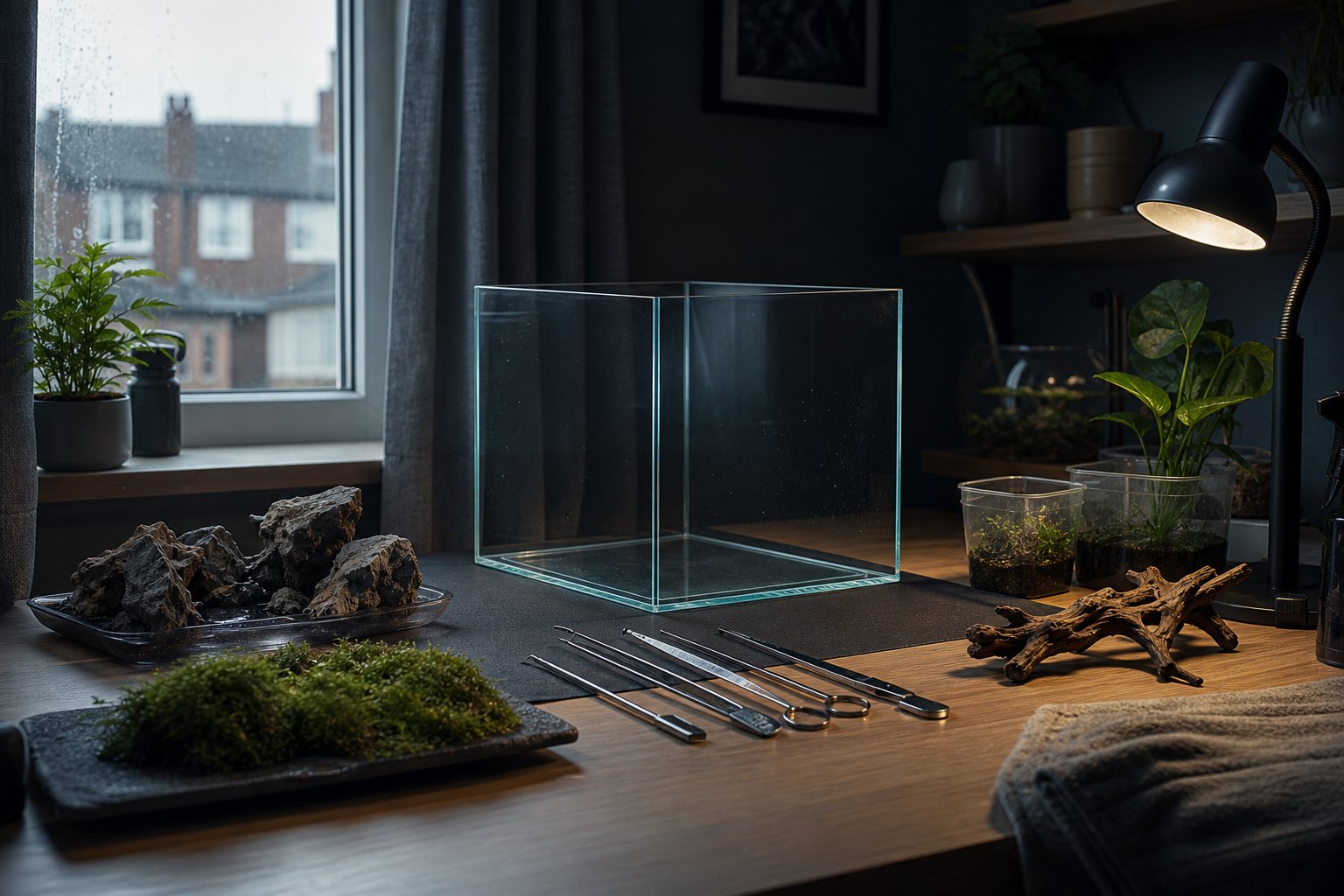
For a first nano tank in the UK, choose 20–40 litres: big enough to hold stable temperature and water chemistry through British nights, small enough for any desk, shelf or rented flat. Budget for a heater, a gentle filter, a programmable light and live plants — then cycle before any fish.
Why 20–40 litres is the UK sweet spot
“Nano” covers anything under 50 litres, and the marketing photos love the tiny 10–15 litre cubes. Resist them for a first tank. Small water volumes are unstable water volumes: temperature swings faster, waste concentrates quicker, and mistakes that a 30-litre tank absorbs will crash a 10-litre one in hours. This matters double in Britain, where centrally heated homes routinely drop several degrees overnight in winter — a 10 L tank tracks the room down; a 30 L tank rides it out with a properly sized heater.
UK-focused care guides have converged on the same recommendation: 20 L as the ethical minimum for a betta, 30–40 L as the comfortable beginner zone where maintenance is a pleasant weekly rhythm instead of a rescue operation. The counterintuitive truth of this hobby: bigger is easier, right up until you cannot lift the water changes.
The full kit list (with the numbers that matter)
Tank: rectangular, longer than tall. A 30–40 L “long” gives fish swimming distance and plants a lit footprint; tall narrow tanks look architectural and keep nothing happy. Glass over acrylic at this size — scratch resistance wins.
Heater — 25–50 W, adjustable, with a guard. The non-negotiable in a UK nano. Follow the 1 W per litre baseline (a 50 W unit suits up to 50 L in a heated room; see our full wattage guide for cold-room corrections). Two features matter disproportionately at nano scale, where a heater fault has less water to dilute it: an accurate, verifiable thermostat, and dry-run protection for water changes that expose the element. A compact unit with an external controller — the design approach of our titanium heater range — means you adjust temperature without wet sleeves and can see the measured temperature from across the room, which is exactly the glanceable verification small tanks reward. Set 24–26°C for tropicals.
Filter — gentle flow, biological media. Nano fish and shrimp dislike currents. A small sponge filter on a quiet air pump, or an adjustable internal filter turned low, is ideal — our small-aquarium filter guide compares the options. Avoid anything whose flow you cannot throttle.
Light — programmable beats powerful. In a shallow nano, even a modest LED delivers strong light to the substrate, so control matters more than output: a fixture with a built-in daily cycle (sunrise/day/moonlight) and dimming lets you run the disciplined 6-hour schedule a new tank needs — the single biggest algae-prevention decision you will make, as our light duration guide explains. Clip-on designs suit rimmed nano tanks and lidded setups; check the mount fits your lid cut-out before buying.
Lid. Not optional in Britain: it slows evaporative heat loss (your heater’s biggest enemy), keeps humidity off the light, and prevents the discovery that bettas and shrimp are escape artists.
Substrate and plants: 2–3 cm of fine gravel or sand for a fish-focused tank; nutrient soil if plants lead. Plant from day one — Anubias and Java fern tied to hardscape, Cryptocoryne in the substrate, and a few stems of fast-growing hornwort or a floating plant as your nutrient sponge. Live plants are the cheapest water quality equipment in the hobby.
The unglamorous essentials: dechlorinator (UK tap water is always chlorinated), a liquid test kit for ammonia/nitrite/nitrate, a separate thermometer to verify the heater, and a small siphon.
Realistic all-in budget: £90–150 excluding livestock, less if you catch tank kits on sale.
Stocking a nano honestly
The hard rule: small tank, small and few inhabitants.
- One male betta — the classic nano centrepiece for 20–40 L. Gentle filter flow, 25–26°C, plants to patrol, no fin-nipping tankmates. Usually happiest alone.
- Cherry shrimp colony — the best beginner invertebrate: hardy, active, algae-grazing, and they breed readily in stable water. A 20 L planted tank with 10–15 shrimp is a self-entertaining ecosystem.
- Micro-schoolers — in 30–40 L: ember tetras, chili rasboras or pygmy corydoras, in groups of 8+. One school, done — resist the pick-and-mix.
- Snails — nerites for algae duty (they cannot breed in freshwater; no plague).
Skip entirely at this size: goldfish (they need 100 L+ and cold water), angelfish, gouramis beyond the sparkling gourami, “algae eater” plecos (most outgrow nano tanks several times over), and any shop assistant’s suggestion of “just one” of something 8 cm long.
The first eight weeks
- Week 0: aquascape, fill, dechlorinate, heater to 25°C, filter on, light on a 6-hour timer. Add bottled beneficial bacteria if you like — it helps, it is not magic.
- Weeks 1–4: fishless cycle. Dose a small ammonia source and test every few days; you are growing the bacteria that convert ammonia → nitrite → nitrate. The cycle is done when ammonia and nitrite hit zero within 24 hours of dosing. Plants can go in from day one; livestock cannot.
- Expect the brown phase: diatom algae dusts every new tank around weeks 2–6. It passes on its own. Do not add light, do not panic — hold the 6-hour schedule.
- Weeks 5–6: first livestock, in one small group. Feed lightly — once daily, eaten in two minutes; in nano volumes, overfeeding is the number-one killer.
- Week 8 onward: the rhythm. Weekly 25–30% water change with temperature-matched, dechlorinated water; glass wipe; filter sponge rinsed in removed tank water (never tap water) monthly. Fifteen minutes a week, total.
The honest pitch for going nano
A 30-litre planted nano on a UK desk costs about £3 a month to run, asks fifteen minutes a week, and gives back a living aquascape that changes daily. The entire trick is stability in a small volume — which comes down to the boring buys: right-sized heating you can verify, gentle filtration, a light on a schedule, and plants doing silent chemistry for you. Get those four right and nano fishkeeping is not the hard mode the forums warn about; it is the most rewarding small hobby in the house.