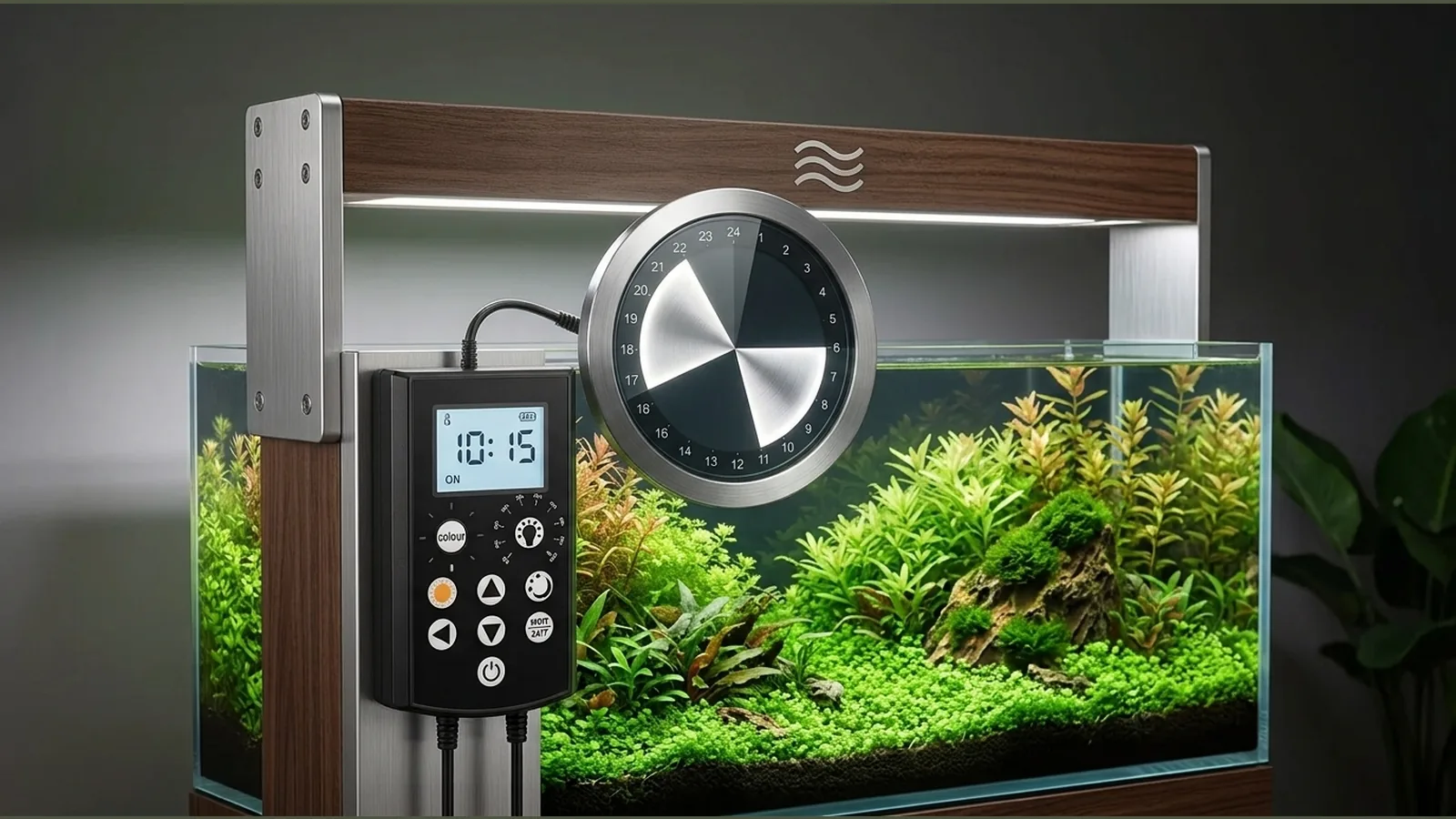
Split photoperiod planted aquarium: a viewing schedule, not an algae shortcut
Direct answer
A split photoperiod planted aquarium schedule divides the day’s lighting into two shorter blocks—typically morning and evening—so you can enjoy the tank when you are home, without treating a midday break as an algae cure. Keep the total daily light period consistent on a timer, start conservatively, and adjust only after watching plants and algae together with nutrients, CO2 and maintenance.
Define a split photoperiod
A split photoperiod (sometimes called a siesta-style or two-part aquarium light schedule) means two timed on-periods in one day, with a lights-off gap between them. Common household patterns are morning and evening blocks that match when people are actually looking at the tank.
This is a viewing and routine choice. It is not proof that splitting light automatically improves plant growth or suppresses algae. Exact controller programme options vary by fixture, so plan the hours first, then set whatever timer you have to match that plan.
Why total light and consistency matter
UK planted-aquarium guidance stresses a consistent, timer-controlled period and warns that an overly long daily duration can encourage algae. During establishment, specialist plant growers also favour a conservative, consistent period and remind keepers to check the timer.
Algae management depends on the balance of light, CO2, nutrients and maintenance—not on timing alone. A midday gap does not replace that balance. Whether you use one block or morning and evening aquarium lights, the useful habits are the same: fixed start and stop times, a total duration suited to your setup, and patience while the tank settles.
Decision table by household schedule
Use this as a planning aid for a two-part aquarium light schedule. Hours are examples for discussion, not universal prescriptions—tanks differ in planting density, fertiliser, CO2 and maturity.
| Household pattern | Example split | Notes |
|---|---|---|
| Away all day, home evenings | Short morning block + longer evening block | Favour the viewing window; keep total hours modest at first |
| Home mornings and evenings | Two similar blocks with a midday gap | Useful for an aquarium lighting siesta schedule when both ends of the day matter |
| Irregular shifts | One fixed block on the days you can keep | Consistency usually beats chasing every lifestyle change |
| New or recovering planted tank | Shorter total daily light, one or two blocks | Establish a baseline before lengthening either session |
Set one baseline
Pick one total daily lighting budget and stick to it for a few weeks. If you prefer a split, divide that same total into two blocks rather than adding a second full “day” of light.
- Write down on and off times for each block.
- Use a timer so the schedule does not drift.
- Avoid lengthening both sessions at once when plants look hungry for light—change one variable at a time.
- Do not assume every planted tank needs the same duration.
Observe plants and algae
After you set the baseline, watch growth tips, leaf colour and any algae films or spots alongside your usual water changes and dosing. If algae rises after you extend light, shorten the total period or review nutrients and CO2 before blaming the midday gap itself.
Prevention of algae in a planted aquarium is multi-factor: light duration and intensity sit beside fertiliser, carbon supply and maintenance, not instead of them.
When one block is simpler
A single continuous photoperiod is often clearer when you want fewer timer settings, a shared household routine, or a newly planted tank that needs predictable conditions. If a split schedule is hard to keep consistent, one reliable block is the better choice.
Soft product next step
If you want a full-spectrum LED with a display timer controller for a roughly 50–60 cm tank, review the GAKO GK160-45 aquarium light product details and map its timer to the baseline hours you chose here—as a schedule decision, not a button-by-button tutorial.
FAQ
Does a split photoperiod planted aquarium schedule stop algae?
No. A midday break is not an algae cure. Algae responds to the wider balance of light, CO2, nutrients and maintenance.
How long should each morning and evening block be?
There is no single answer for every tank. Choose a conservative total daily period, split it to match when you view the aquarium, then adjust slowly after observation.
Is an aquarium lighting siesta schedule better than one continuous period?
Neither is universally better. Splits mainly help viewing habits; one block is often simpler to keep consistent.
What matters more than morning evening aquarium lights timing?
Consistency on a timer, a total duration that suits your plants, and steady husbandry matter more than the shape of the gap between sessions.